of workers estimate they could save six or more hours a week if repetitive tasks were automated.
Source: Smartsheet, Automation in the Workplace survey (2017)Service 11
API Integration Services That Connect Your Business Software
Your CRM, accounts, payments and online store working as one system, with no copying and pasting.
Cyber Ghost provides API integration services for UK businesses. We connect the tools you already use, monitor integrations after launch and give you ownership of custom integration code.
- Fixed-price projects
- Monitored after launch
- You own the code
- ConnectedTools that talk to each other
- No re-entryData flows automatically
- DocumentedSecure, maintainable integrations
Overview
Stop Copying Data Between Systems
When your tools do not talk to each other, your team becomes the connection. Orders are retyped into accounts, contacts are copied into the CRM and stock is updated by hand. It is slow, mistakes creep in and the workload grows with every new customer.
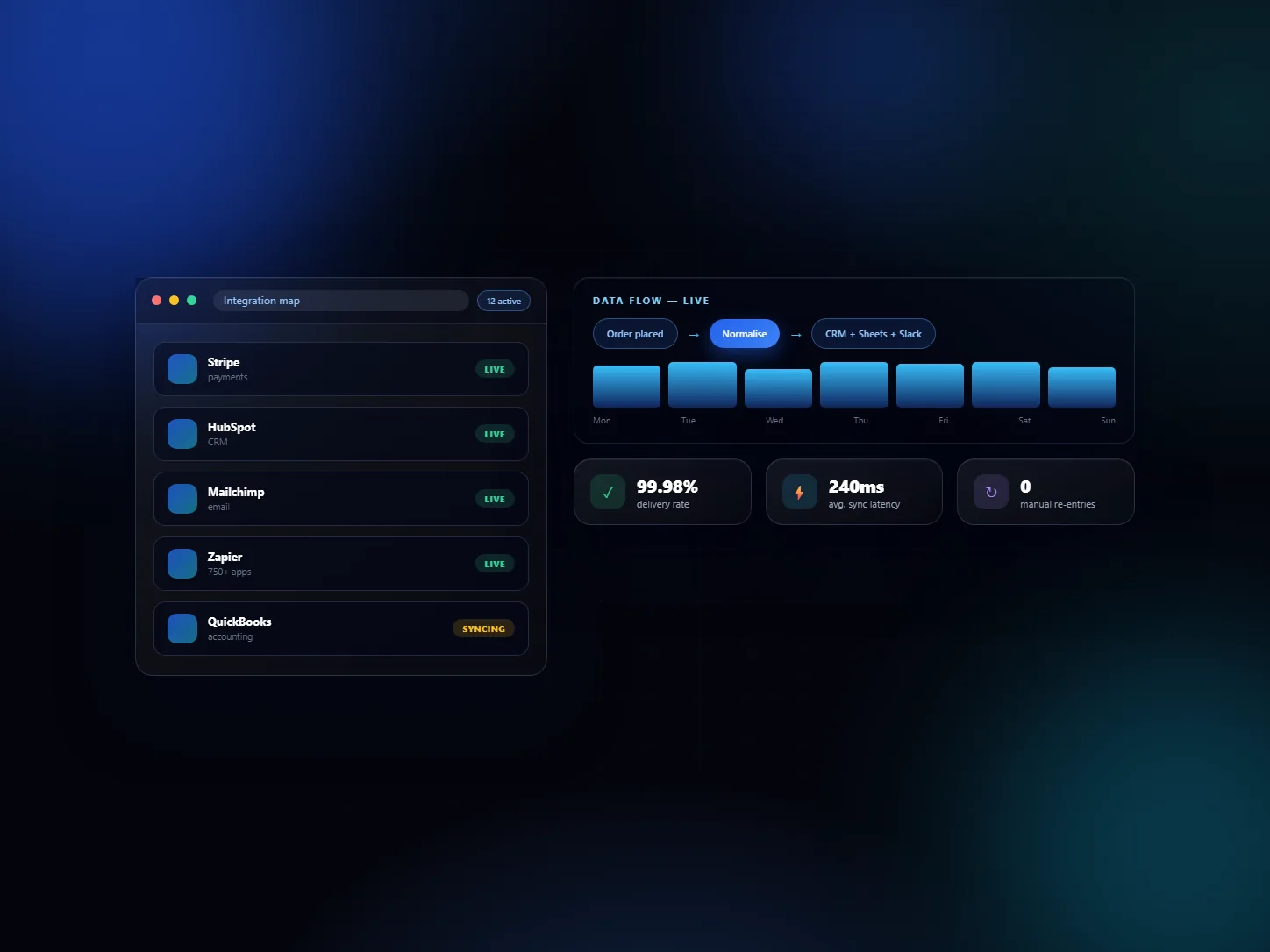
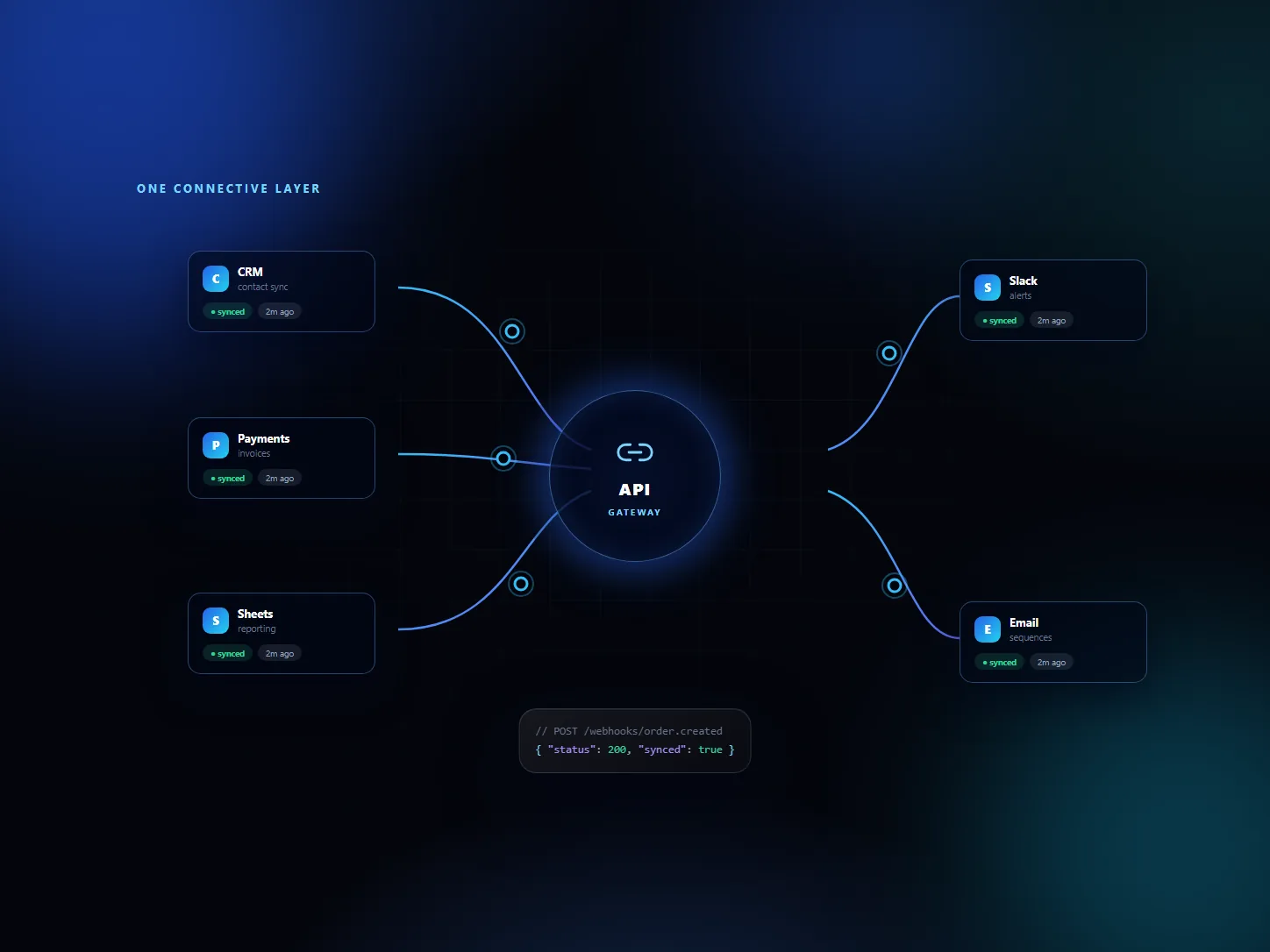
System integration removes the manual step. Data can move automatically between your systems, accurately and in real time, based on the capabilities and limits of each platform.
In a Smartsheet survey, nearly 60% of workers estimated they could save six or more hours a week if repetitive tasks were automated. We map your workflow first, then recommend a connector or custom integration based on what your systems need to do.
Did You Know?
Our services
Software Integration Services
Connect your CRM, accounting, payments, ecommerce, inventory and workplace tools to the workflows your business relies on.
CRM Integration
Connect HubSpot, Salesforce or Zoho with website forms, sales and support workflows so contacts can be captured automatically.
Accounting and Finance Integration
Sync invoices, payments and customer records with accounting tools such as Xero, QuickBooks or Sage.
Payment Gateway Integration
Connect payment providers such as Stripe, PayPal or GoCardless so payment records can flow into your accounts.
Ecommerce and Inventory Integration
Connect Shopify or WooCommerce to stock, fulfilment and accounting workflows so order and inventory data stays aligned.
Custom API Development
Secure, documented APIs that allow your platform to share data with partners, apps or other systems.
Data Sync and Workflow Automation
Use two-way syncs, webhooks and scheduled updates to keep systems consistent without manual effort.
Tools we connect
Tools We Connect
These are examples from the brief. We confirm platform access and API capabilities during discovery before recommending an integration.
CRM and marketing
- HubSpot
- Salesforce
- Zoho
- Mailchimp
Accounting and payments
- Xero
- QuickBooks
- Sage
- Stripe
- PayPal
- GoCardless
Commerce and workplace
- Shopify
- WooCommerce
- Google Workspace
- Microsoft 365
If a system provides a suitable API, it can often be connected. We check the available capabilities, permissions and limits before confirming scope.
Choose the right approach
Connector or Custom Integration?
For simple, low-volume tasks, a connector such as Zapier or Make may be enough. A custom integration can be a better fit when volume, process complexity or reliability requirements grow.
| Consideration | Connector tools (Zapier, Make) | Custom integration |
|---|---|---|
| Set-up cost | Usually lower for simple workflows | Higher initial build investment |
| Running cost | Monthly fees may rise with usage | No per-task connector fees; hosting or support may still apply |
| Reliability | Works well for straightforward tasks | Can include tailored error handling and monitoring |
| Flexibility | Limited to available triggers and actions | Designed around your specific process |
Built for trust
Security, Monitoring and Reliability
An integration is only useful if you can trust it. We plan access, data handling, failure visibility and handover as part of the build.
Secure authentication
API keys and tokens are stored securely, not in plain text.
Encrypted data
Data is protected in transit and handled in line with applicable data-protection requirements.
Least-access permissions
Each connection is scoped to the information and actions it needs.
Failure alerts
Alerts can flag when an integration stops or falls behind.
Logs and retries
Transfers are recorded, with failed messages retried and duplicate processing guarded against.
Documentation
Clear handover notes explain how each integration works.
Why work with us
Why Choose Cyber Ghost
Hours back every week.
Your team stops retyping data and focuses on customers.
Fewer errors.
Automated transfers remove the mistakes manual entry creates.
Honest advice.
If a connector tool will do the job, we will recommend it.
Fixed prices.
You know the cost before work begins.
Monitoring as standard.
Problems are caught before they affect your business.
You own the code.
Custom integrations and documentation belong to your business.
One team for digital.
Website, software and integrations built to work together.
The Process
Our Integration Process
Five clear stages, with a fixed price agreed before the build begins.
- 1
Review Your Systems
We map your workflow and review what each system’s API can do.
- 2
Plan and Fixed Quote
You review and approve the field mapping, sync rules and written price.
- 3
Build
We develop the integration with error handling for the agreed workflows.
- 4
Test With Real Data
We test edge cases, expected volumes and failure scenarios before launch.
- 5
Launch and Monitor
We launch, configure agreed alerts and hand over the integration documentation.
Cost and timelines
Integration Cost and Timelines
Cost depends on each system’s API quality, whether data flows one way or both, and the volume of records. Every project receives a fixed written quote.
| Integration | From | Typical timeline |
|---|---|---|
| Simple one-way connection | Fixed quote after review | Agreed after scoping |
| Two-way data sync | Fixed quote after review | Agreed after scoping |
| Custom API | Fixed quote per project | Agreed after scoping |
Optional support plans can cover monitoring, updates when third-party APIs change and new connections. Support scope and pricing are confirmed separately.
Get a Free Integration QuoteFrequently asked questions
API Integration FAQs
A simple connection between two systems generally costs less than a two-way sync or custom API. Cost depends on each system’s API and the project scope, and you receive a fixed written quote before work begins.
Timing depends on each system’s API quality, the number of systems and the sync rules. Two-way syncs and custom APIs can take longer. We agree the schedule after reviewing the scope.
If a system has an API, we can usually connect it. We review each system’s capabilities before quoting so there are no surprises about what is supported.
Zapier or Make suits simple, low-volume tasks. A custom integration is a better fit for high volumes, complex rules or business-critical data. If a connector tool will do the job, we will recommend it.
Integrations include agreed failure alerts and logs so issues can be identified and investigated. Monitoring and response arrangements are confirmed as part of the project scope.
We use secure authentication, encryption and minimal access. Custom integration code and documentation belong to your business, with ownership and handover set out in the project agreement.
API Integration Services
Get a Free Integration Quote
Tell us which systems you use and what should happen between them. We will review the workflow and recommend a clear way to connect them.
- Fixed price
- Monitored after launch
- You own the code
Often bought together
Related services
Most clients start with one service and add a second or third as the work grows — the links below point to the services that make the most sense next.
Ready to start your API & Software Integrations project?
Free consultation · UK-based team · Strategy within 48 hours.